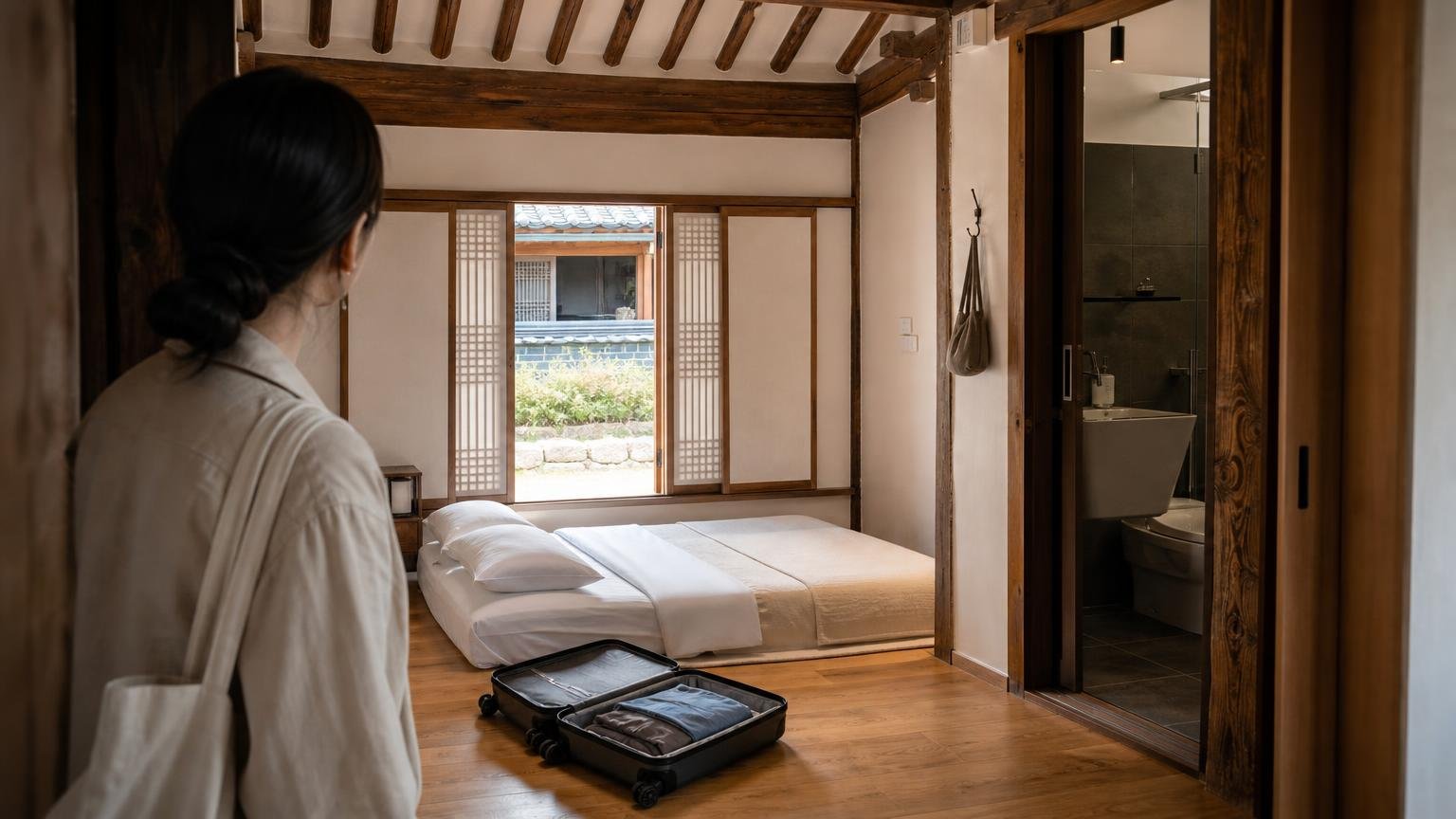
A hanok label does not tell you whether your room has a bed, a private indoor bathroom or enough space for open suitcases. Confirm these details before reserving.
Key Takeaways
- Confirm the sleeping arrangement for the exact room, including permanent beds, floor bedding and topper dimensions.
- Maximum occupancy does not necessarily equal permanent-bed capacity or comfortable luggage space.
- Ask whether the bathroom is en suite, shared or outside the sleeping building, and confirm the route to it.
- Check ondol heating separately from the sleeping surface; an ondol room does not automatically mean every guest sleeps on the floor.
- For Seoul stays near Anguk, official lockers may provide a fallback when the room or property cannot store large luggage.
A hanok booking can include a permanent bed, floor bedding or both. Its bathroom might be private and indoors, or located outside the sleeping building. Maximum occupancy may also include guests sleeping on temporary toppers. This hanok stay Korea guide explains what to verify for the specific room you plan to reserve—not simply for the property as a whole.
Why the Room Type Matters More Than the Property Label
Korea Tourism Organization guidance notes that many hanok stays use floor mats and blankets instead of beds. It recommends confirming the room type when a traveler requires a bed and cautions that some properties may not provide the modern conveniences guests expect.
That does not mean every hanok guest sleeps on the floor. KTO’s listing for Irang Hanok Stay provides a useful counterexample: each of its four independently rented houses has an ondol room and a bedroom, as well as a kitchen and living area and a bathroom. The property is also classified as offering rooms with beds.
The practical lesson is to read the layout at room or unit level. “Hanok,” “ondol” and “bedroom” can appear within the same accommodation, so none of those terms alone confirms where every guest will sleep.
1. Check the Sleeping Setup for Every Guest
Confirm the number of permanent beds
Do not use maximum occupancy as a substitute for bed capacity. The official Seoul tourism listing for Songhyeon Dami, edited in July 2024, describes a unit for as many as four guests but lists only one queen-size bed. The other two guests use topper bedding. The listing does not state the topper dimensions, where the toppers are placed or how much free floor and luggage space remains when four people stay.
Before booking, ask:
- How many permanent beds are in the selected room or unit?
- What are the bed dimensions?
- Which guests will use floor mats, blankets or topper bedding?
- What are the dimensions and thickness of that bedding?
- Where is temporary bedding placed when the room is at maximum occupancy?
- How much clear floor space remains after all bedding is laid out?
Match the arrangement to your needs
A room with floor bedding may suit travelers who are comfortable sleeping at floor level. A permanent bed may be more appropriate for someone who specifically requires one. Mixed groups should establish the arrangement for each person rather than assuming that a listing’s bed symbol applies to the entire unit.
Ask the property to identify the exact sleeping room on your reservation. General property descriptions may combine features from several room types.
2. Establish Where the Bathroom Is
“Bathroom available” is not a complete answer. You need to know whether the selected room has a private en suite bathroom, uses a shared facility or requires guests to leave the sleeping building.
KTO’s listing for Manjukjae House, an approximately 360-year-old preserved residence with four two-person guest rooms, lists an outdoor bathroom. The page does not explain how far it is from each room, whether it is shared or whether guests must cross an uncovered courtyard.
Those missing details can be important during winter or for anyone with mobility needs. Request a room-specific explanation covering:
- Whether the bathroom is private or shared
- Whether it is attached to the room
- Whether guests must go outside to reach it
- The approximate route and distance from the sleeping room
- Whether any part of the route is uncovered
Other hanok stays have more modernized arrangements. The live official Seoul listing for Hanok Guesthouse Suni describes all four rooms as having private bathrooms, along with bidets, hair dryers, towels and shampoo. However, that page was published and last edited in 2021, so travelers should reconfirm the facilities currently supplied in their particular room.
3. Separate Ondol Heating from the Sleeping Surface
Ondol refers here to floor heating, but an ondol room does not by itself answer whether you will sleep on a bed or on floor bedding. Irang Hanok Stay’s combination of an ondol room and a bedroom shows why heating and sleeping arrangements should be checked separately.
Likewise, the Seoul tourism listing for Hanok Guesthouse Suni describes all rooms as having ondol floor heating and cotton bedding, while also listing private bathrooms. Because that listing was last edited in 2021, treat it as an example of how amenities can be combined rather than a guarantee of current conditions.
For the room you are booking, ask:
- Does this specific room have ondol floor heating?
- Does it contain a permanent bed, floor bedding or both?
- How many bedding sets are supplied for the booked occupancy?
- Can the property confirm the current bedding arrangement in writing?
Avoid treating “ondol,” “traditional room” or a property-wide bed classification as a complete description. The selected room’s configuration is what matters.
4. Calculate Space for Luggage After Bedding Is Set Up
A listed capacity tells you how many guests the property accepts; it does not necessarily reveal how much usable floor area remains. This distinction is especially important when temporary bedding must be placed on the floor.
Songhyeon Dami’s published arrangement illustrates the issue: a four-person maximum occupancy combines one queen-size bed with topper bedding for two additional guests, but the listing gives no room area or remaining suitcase space.
Send the property your suitcase count and approximate sizes, then ask:
- Where can suitcases be stored inside the unit?
- Can large cases remain open after all bedding is arranged?
- Is there a separate luggage area?
- Is luggage storage available before check-in or after check-out?
- Does storage need to be reserved in advance?
A Seoul fallback near Anguk
If a Seoul hanok cannot hold large suitcases or does not provide pre-check-in storage, the Luggage Lounge Anguk Locker is one possible fallback. According to the Seoul Tourism Organization, the self-service facility is approximately three minutes from Anguk Station Exit 4 and about 30 seconds from the Changdeokgung Airport Bus stop.
It is listed as open daily from 05:00 to 24:00, with small, medium, large and extra-large lockers, including options intended for large suitcases. Four-hour and eight-hour passes are available. Payment is by card, and advance online reservations are supported without requiring an app.
This is a Seoul-area option rather than a nationwide solution. Prices vary by locker size and day, and cash is not accepted. Check the linked official source or the on-site kiosk for current availability, terms and prices.
A Room-by-Room Message to Send Before Booking
A concise written request can prevent several common ambiguities:
“For the exact room or unit I am considering, please confirm the number and dimensions of permanent beds; the number, type and dimensions of floor or topper bedding; where that bedding is placed; whether the bathroom is private, shared, en suite or outside; whether the room has ondol floor heating; and how much space is available for our luggage at full occupancy. Please also confirm whether luggage storage is available before check-in or after check-out.”
Keep the answer with your reservation details. If a listing is old or describes the property generally, ask the host to reconfirm the current setup before payment.
What This Means
A hanok stay should be selected by exact room configuration, not by atmosphere or property label alone. Travelers who require a bed need confirmation of the permanent-bed count. Groups using maximum occupancy should determine who receives temporary bedding and where it will be placed. Anyone concerned about privacy, winter access or mobility should establish the bathroom route, while travelers with large cases should calculate luggage space after all bedding is in use.
Official tourism listings provide useful starting points, but they do not always include measurements, routes or storage details. Facilities and policies can also change. Review the linked official source and obtain room-specific confirmation directly from the property before booking.
Sources
- Korea Tourism Organization — Hanok Accommodations: https://english.visitkorea.or.kr/svc/contents/contentsView.do?vcontsId=140678
- Korea Tourism Organization — Irang Hanok Stay: https://english.visitkorea.or.kr/svc/contents/contentsView.do?vcontsId=45149
- Korea Tourism Organization — Manjukjae House: https://english.visitkorea.or.kr/svc/contents/contentsView.do?menuSn=353&vcontsId=34165
- Seoul Tourism Organization — Hanok Guesthouse Suni: https://english.visitseoul.net/Accommodation/stayView/608?bestBy=&curPage=84&sortOrder=1&srchWord=
- Seoul Tourism Organization — Songhyeon Dami: https://english.visitseoul.net/Accommodation/stayView/10475
- Seoul Tourism Organization — Luggage Lounge Anguk Locker: https://english.visitseoul.net/other/Luggage-Lounge-Anguk-Locker/ENPy2nopb
